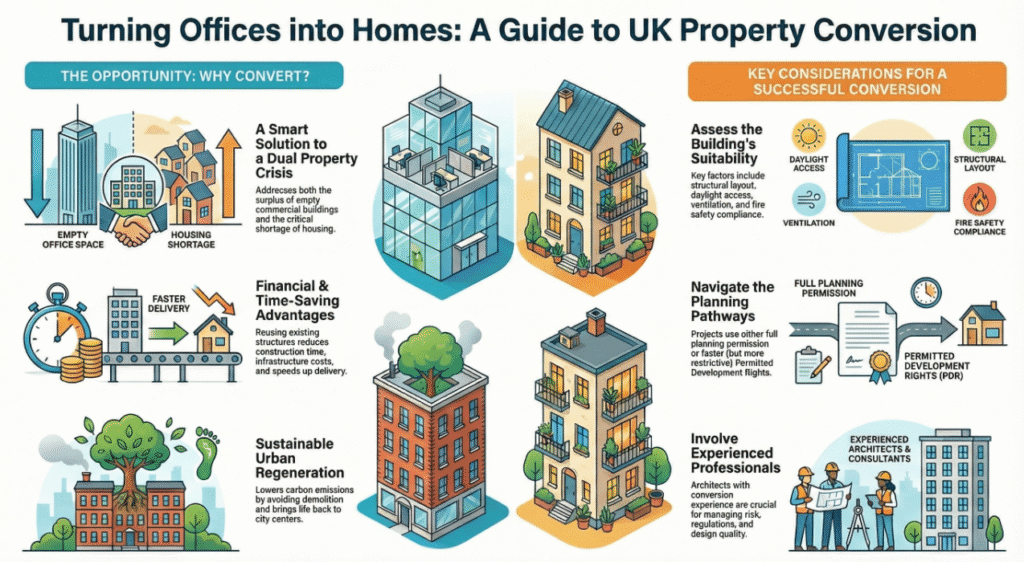
Commercial to residential conversion has become a practical response to several problems facing the UK property market at the same time. Many towns and cities are dealing with empty offices, struggling high streets, and a serious shortage of housing. At the same time, building new homes from scratch is becoming slower and more expensive due to land constraints and rising construction costs. Converting existing commercial buildings into homes offers a way to reuse what already exists while increasing housing supply in well-connected locations. For property owners, developers, and local authorities, this approach helps reduce vacancy, bring life back into underused areas, and deliver homes faster. As pressure grows on urban housing, commercial to residential conversion is playing a growing role in reshaping how UK cities develop.
What Does Commercial to Residential Conversion Mean in Today’s Property Market?
Commercial to residential conversion refers to the process of changing a building originally used for commercial purposes into residential accommodation. This can include office to residential conversion, retail to residential conversion, or the reuse of industrial buildings as homes. In planning terms, this involves a change of use, usually from a commercial use class to a residential one. Some projects involve full conversion, where the entire building becomes housing, while others create mixed-use schemes that retain ground-floor commercial space with homes above. The aim is to adapt existing buildings to suit current demand rather than leaving them vacant. In today’s property market, this approach reflects a shift in how space is valued and used, especially in town centres and business districts.
Why Is Commercial to Residential Conversion Increasing Across the UK?
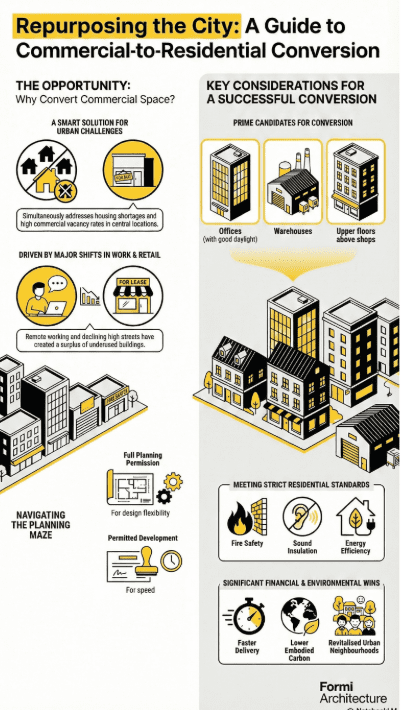
The rise of commercial to residential conversion across the UK is closely linked to changes in how people work, shop, and live. Remote and hybrid working have reduced demand for traditional office space, leaving many buildings underused or empty. At the same time, the decline of high-street retail has created surplus commercial stock in central locations. These changes sit alongside an ongoing UK housing shortage, particularly in cities where demand for homes remains high. Government policy and planning guidance increasingly support property repurposing as a way to deliver housing without expanding urban boundaries. Together, these factors make conversion an attractive option for dealing with vacant commercial buildings while responding to housing pressure.
Which Types of Commercial Buildings Are Most Suitable for Residential Conversion?
Not all commercial buildings are equally suited to residential conversion, and suitability depends on layout, structure, and location. Offices are among the most common candidates, especially those with shallow floor plates that allow good daylight and ventilation. Larger, deep-plan offices can be more challenging but may still work with careful design. Retail units, particularly upper floors above shops, are also suitable and often overlooked. Light industrial buildings and warehouses can offer generous ceiling heights and open layouts that adapt well to housing. Former public and institutional buildings, such as schools or offices, often sit in established areas and provide strong structural frameworks. Each building type requires a tailored design approach to meet residential standards.
How Do Architects Assess Whether a Commercial Building Can Be Converted?
Architects begin by assessing the physical characteristics of a building to judge whether conversion is practical and compliant. Key factors include the structural grid, which affects how easily spaces can be divided into homes, and floor-to-ceiling heights, which must meet residential standards. Access to daylight and natural ventilation is critical, as homes require a higher level of comfort than many commercial uses. Architects also study core locations, such as stairs, lifts, and service risers, to see how they can support residential layouts. Fire escape routes and circulation are reviewed early to ensure safety and compliance. This technical assessment helps reduce risk and guides early design decisions.
What Planning Routes Allow Commercial to Residential Conversion in the UK?
In the UK, commercial to residential conversion usually takes place through either full planning permission or permitted development routes. A common pathway involves changing use from Class E, which covers many commercial activities, to Class C3, which covers residential use. Full planning permission allows greater design flexibility but requires detailed assessment by the local authority. Permitted development offers a faster route in some cases, although it comes with strict limitations. Local authority policies, conservation areas, and site-specific constraints can influence which route is available. Understanding the planning context early helps property owners choose the right strategy and avoid delays during the approval process.
How Do Permitted Development Rights Affect Conversion Projects?
Permitted development rights, often referred to as PDR, allow certain commercial to residential conversions without full planning permission. Under this route, developers must apply for prior approval, which focuses on specific issues such as transport, noise, daylight, and flood risk. PDR can speed up delivery, but it also restricts design freedom and may limit space standards or external changes. Recent legislative updates have adjusted what is allowed, making it essential to confirm current rules. PDR is not always suitable, particularly for complex sites or areas with strong local controls. In such cases, full planning permission may offer better long-term results despite longer approval times.
What Building Regulations Apply to Commercial to Residential Conversion?
All commercial to residential conversion projects must comply with Building Regulations, regardless of the planning route. Fire safety is a major consideration, including protected escape routes, fire separation, and alarm systems. Sound insulation standards are higher for residential use, requiring careful detailing between homes and from external noise sources. Thermal performance upgrades are often necessary to meet current energy standards, which can involve new insulation, windows, and heating systems. Accessibility requirements also apply, particularly in larger developments. Meeting these regulations often involves significant upgrades to existing buildings, and early coordination between design and technical teams helps ensure compliance without excessive cost.
What Are the Financial Benefits of Converting Commercial Buildings into Homes?
From a financial perspective, commercial to residential conversion can offer clear advantages over new-build development. Reusing an existing structure often reduces construction time and avoids costs linked to foundations and major infrastructure. Many commercial buildings already have connections for services such as water, drainage, and electricity, which can lower initial expenditure. Faster delivery can improve cash flow and reduce holding costs. Converted homes in central locations often attract strong rental demand and stable resale values. While conversion costs can vary widely, especially depending on building condition, this approach is widely viewed as a cost-effective development option when assessed against time, location, and long-term returns.
What Technical Challenges Are Common in Commercial to Residential Conversions?
Despite the benefits, commercial to residential conversions present technical challenges that require careful design input. Deep floor plates can limit access to daylight, making layout planning more complex. Structural alterations may be needed to support new loads or create openings, which can affect budgets and timelines. Integrating modern services, including drainage and ventilation, into existing buildings often requires creative routing solutions. Overheating risk is another concern, particularly in offices with large glazed areas. Addressing these challenges relies on early analysis and coordinated design decisions. With the right expertise, these issues can be managed while delivering safe, comfortable, and compliant homes.
How Does Architecture and Design Influence the Success of a Conversion?
Architecture and design play a decisive role in whether a commercial to residential conversion feels like a good place to live or simply a reused building. Space planning determines how efficiently apartments function on a daily basis, from storage and circulation to privacy and acoustics. Well-considered layouts make the best use of existing structures while meeting residential standards. Daylight strategies are equally important, with dual-aspect apartments often preferred to improve light levels and ventilation. Where this is not possible, architects use light wells, setbacks, or reconfigured cores to improve internal conditions. Natural ventilation strategies reduce overheating and reliance on mechanical systems. Successful residential conversion design balances efficiency with comfort, ensuring homes feel generous rather than compromised by their former use.
How Can Sustainability Be Integrated into Commercial to Residential Conversion?
Sustainability is one of the strongest arguments for commercial to residential conversion. Reusing existing structures avoids demolition waste and leads to significant embodied carbon savings compared to new construction. Energy performance upgrades are usually required, including improved insulation, better glazing, and efficient heating systems, which lower long-term energy use. Material reuse can include retaining structural elements, reusing bricks or timber, and specifying low-impact finishes. These measures support low-carbon refurbishment while improving building performance. Over time, operational efficiency becomes a major benefit, as well-insulated and well-ventilated homes require less energy to heat and cool. Sustainable conversion focuses on long-term performance rather than short-term gains, supporting responsible reuse of buildings.
How Do Commercial to Residential Conversions Support Urban Regeneration?
Commercial to residential conversions play a key role in urban regeneration by bringing people back into areas that have lost activity. Vacant offices and empty retail units can create inactive streets and weaken local economies. Converting these buildings into homes increases footfall and supports local shops, services, and transport networks. This approach also adds housing supply without pushing development into green spaces or encouraging urban sprawl. Brownfield redevelopment allows towns and cities to grow more efficiently by using existing infrastructure. Over time, increased residential presence can improve safety, street life, and local identity. By reusing underused buildings, conversions help stabilise neighbourhoods and support long-term regeneration goals across the UK.
When Is Commercial to Residential Conversion the Right Strategy for a Property?
Commercial to residential conversion is most suitable when a building is structurally sound, well-located, and no longer viable for its original use. Indicators include long-term vacancy, declining rental income, and strong demand for housing in the area. Buildings with reasonable floor-to-ceiling heights and access to daylight tend to perform better as homes. In some cases, demolition or full redevelopment may be more appropriate, particularly if the structure is heavily compromised or poorly located. Risk and reward should be assessed carefully, including planning risk, construction cost, and long-term demand. A clear view of long-term viability helps determine whether conversion offers lasting value rather than short-term gain.
Why Should You Work with an Architect Experienced in Commercial to Residential Conversion?
Working with an architect who understands commercial to residential conversion reduces risk and improves outcomes. Experienced professionals bring planning strategy and feasibility knowledge that helps identify suitable routes early. This includes understanding change of use policy, permitted development limitations, and local authority expectations. Regulatory risk is managed through early coordination of fire safety, accessibility, and acoustic requirements. Design quality is balanced with compliance, ensuring homes meet standards without unnecessary cost. Programme and budget control also benefit from experience, as conversion projects often uncover hidden conditions. A specialist architect provides clarity throughout the process, helping property owners make informed decisions and avoid common pitfalls associated with change of use projects.
How Does Formi Architecture Approach Commercial to Residential Conversion Projects?
Formi Architecture approaches commercial to residential conversion with a focus on clarity, performance, and long-term value. Each project begins with careful assessment of the building, planning context, and client objectives. A planning-led process helps define the most appropriate strategy, whether through permitted development or full application. Technical decisions are guided by building performance, energy efficiency, and compliance rather than appearance alone. Sustainability is integrated through reuse of structure, energy upgrades, and responsible material choices. Design decisions are grounded in practical delivery and future use, ensuring homes are comfortable and durable. This approach reflects experience across complex refurbishment and conversion projects while maintaining a clear, responsible architectural direction.
Is Commercial to Residential Conversion a Viable Solution for Today’s Housing Needs?
Commercial to residential conversion offers a realistic response to current housing and development pressures, but it is not a universal solution. It works best where buildings are well-located, underused, and capable of meeting residential standards. Benefits include faster delivery, reduced environmental impact, and efficient use of existing infrastructure. Challenges remain around design quality, regulation, and long-term performance, which require informed decision-making. Policy support and market demand continue to drive interest in this approach, particularly in urban areas. Property owners, developers, and local authorities can benefit most when conversion is guided by clear assessment and professional expertise. Exploring feasibility early helps determine whether this strategy delivers lasting value.